
Since its founding, ROR has been committed to providing open infrastructure for the global community. As part of this commitment, in December 2020, ROR released a public self-assessment of our alignment with the Principles of Open Scholarly Infrastructure (POSI).
At the time, the POSI framework, originally articulated in 2015, had been recently (re)codified as a set of concrete guidelines, inspiring a small group of open scholarly infrastructure initiatives to assess how they were aligned with these principles.
For ROR, this context was particularly relevant as it was in the early stages of formalizing an operating model and exploring pathways to long-term sustainability. POSI provided a helpful roadmap to inform ROR’s strategic decision-making and a useful framework for contextualizing and organizing its operations.
A revised version of the Principles of Open Scholarly Infrastructure (v2.0) was released in October 2025 (following a minor v1.1 revision in November 2023). As an early POSI adopter and a member of the POSI adopters group that formed after the 2020 recodification, ROR was involved in shaping the revision alongside other community collaborators. The v2.0 revision does not alter the spirit or intent of the principles, but rather clarifies and expands on some key points and nuances that emerged through community consultations and also in response to ongoing changes in the scholarly infrastructure landscape.
In the wake of the POSI v2.0 release, in recognition of the five years since our initial self-assessment, and having recently marked the milestone of ROR’s seventh anniversary, we wanted to take this opportunity to reflect on the current state of ROR’s alignment with the POSI framework and re-assert our commitment to providing open scholarly infrastructure for the global community.
Evaluation process
The POSI framework focuses on three key areas: accountability (governance), resourcing (sustainability), and protection of community interests (insurance). Twenty principles are articulated within these three areas. The principles are intended to provide guidance; they are not intended to function as a set of rules or a checklist, and it is not expected or required that all of the principles will be relevant for every organization or initiative.
For ROR’s revised self-assessment, we reviewed the updates from POSI version 1.1 and version 2.0 and evaluated ROR’s current and planned activities against these newer versions of the principles.
Similar to the 2020 assessment, we evaluated degrees of alignment with the principles using a “traffic light” ranking, where green indicates strong alignment, yellow indicates partial alignment or alignment in process, and red indicates weak alignment or non-alignment. There is no standard POSI assessment metric; some organizations have adopted the traffic light framework while others have taken different approaches. We present the results of the new assessment alongside the results from the 2020 assessment to indicate where alignment has remained consistent or evolved.
As ROR is a jointly operated initiative and not a standalone organization by design, some of the principles are less applicable than others. If an item is marked as green, this doesn’t necessarily mean ROR does this perfectly or that our work in this area is done; it simply indicates that we feel confident about our level of alignment and continued ability to maintain this alignment.
While we believe that the assessment indicators are helpful for understanding the state of ROR’s alignment at a glance, we also take seriously the details behind the indicators, and care about documenting and understanding the specific actions and decisions make alignment possible, so that we can integrate this work as a daily practice and continue to seek opportunities for growth and improvements over time.
Governance
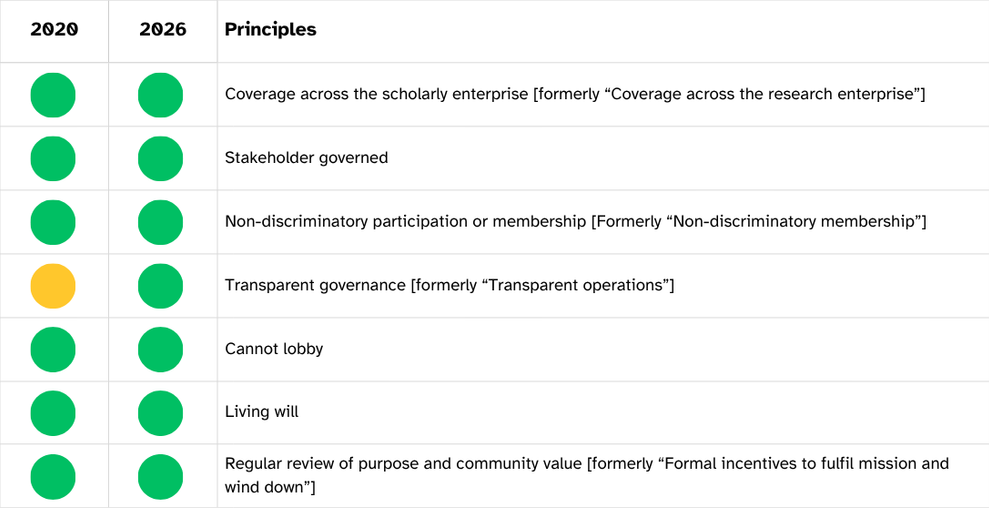
ROR is a global registry that aims to represent all research organizations in the world and to be adopted and used all over the world. ROR IDs and accompanying metadata records encompass a diverse and global set of research organizations and organization types. The registry continues to be updated to include new organizations, particularly from regions historically underrepresented in research infrastructure, and to reflect metadata updates that support global adoption, such as including name variants in multiple languages and character sets.
ROR infrastructure is freely and openly available and can be used in any type of system and anywhere in the world without restrictions.
ROR community activities aim to reflect and support global usage and engagement. Community meetings and case studies feature a range of users and implementations. ROR’s Steering Group, Curation Advisory Board, and community forums similarly encompass and reflect diverse national and regional perspectives as well as a mix of organization types.
While ROR communications and community activities are primarily conducted in English and meetings are primarily conducted during Western Hemisphere working hours, we aim to broaden the linguistic and geographic scope of our communications and activities by producing translations of key community resources, using video translations and captions, scheduling some meetings and events in alternate time zones, and conducting meetings and communications in non-English languages when possible.
ROR is not a standalone organization by design and therefore has no official mechanism for board governance. ROR governance operations are carried out by three nonprofit organizations that are representative of ROR’s key stakeholder communities and specified in an official Memorandum of Agreement.
ROR also engages stakeholder input and guidance on strategic directions through its Steering Group, open community calls, Curation Advisory Board, and public calls for feedback.
As a multi-organization initiative, ROR’s governance model is implemented by its three operating organizations, which are nonprofit organizations that collectively represent key stakeholder communities for ROR and whose commitment to ROR has been approved by their respective governing bodies.
ROR is designed to be a community-driven open infrastructure initiative that has no membership or service model by design and that encourages active community engagement to inform its ongoing activities. ROR infrastructure can be accessed and used by anyone without a membership or a license or any other type of restriction. ROR community activities, such as community meetings and events, calls for feedback, bug reports and feature suggestions, and curation requests are openly available for anyone to opt-in.
As described in more detail elsewhere in this assessment, while ROR’s community activities and communications are conducted primarily in English during Western Hemisphere working hours, we take steps to support multilingual, global, multi-modal, and asynchronous engagement, to convey that all community members are welcome to participate regardless of where they work or how they prefer to communicate. We also seek to highlight users and adopters from a range of organization types and industries.
The registry’s inclusion criteria for organizations is based on adherence to ROR’s scope, which is established by community experts and stakeholders. Any organization can be included in the registry within this scope; there are no fees or licenses or other permissions required to add an organization to the registry or to maintain the metadata associated with the organization’s record.
ROR convenes a Curation Advisory Board and Steering Group made up of members of the community that are invited to provide specific guidance and advice on ROR activities. These groups do not have formal governance authority over ROR. Members are currently selected through an invitation process that is overseen by ROR’s operating organizations and core staff members; anyone is welcome to express interest in participating. Group operations are documented on GitHub and the ROR website.
ROR is operated as a collaborative initiative by California Digital Library, Crossref, and DataCite. The three ROR governing organizations collectively assume and share responsibility for ROR governance, operations, resourcing, and decision-making. These responsibilities are defined in a Memorandum of Agreement (MOA) that is approved by the governance bodies of each organization, renewed on a regular basis, and published on the ROR website. The MOA outlines how ROR governing operations are conducted and also stipulates specific principles of governance, for example, that ROR cannot be governed by, purchased by, controlled by, sold to, or otherwise transferred to a commercial entity.
ROR’s Memorandum of Agreement was first signed in 2020. Since then, the ROR operating organizations have renewed and revised the agreement multiple times to provide more clarity and transparency about ROR’s governance model and to keep the agreement aligned with current operations. The Memorandum of Agreement is now also made available on the ROR website.
ROR’s primary focus is to provide useful infrastructure for the community in the form of data and services that support a variety of use cases and needs. ROR does not lobby nor include regulatory change as part of its remit.
ROR operates on a core set of values and principles, including but not limited to POSI, based on the premise that scholarly infrastructure should be open. These values and principles are not motivated by self-interest but by the belief that open infrastructure provides a collective benefit.
ROR team members and community stakeholders participate in numerous activities and initiatives to advance ROR’s objectives in the name of the common good. Some of these activities and initiatives may directly or indirectly play a role in influencing policy decisions, such as in the emergence of national persistent identifier policies in multiple countries that may specifically mention ROR, but that are focused on addressing the needs of the global research community.
ROR operations and governance structures have accounted for long-term stewardship as well as future scenarios in which the service might be wound down.
ROR data is openly available under a CC0 waiver by default, allowing access to persist beyond the life of the initiative. ROR code is openly licensed on GitHub and can be forked by anyone. ROR data files are published on Zenodo and archived through Zenodo’s processes.
ROR’s operating organizations have a Memorandum of Agreement, which is published on the ROR website, that describes how ROR would be shut down and how relevant responsibilities could be transferred to responsible successors, if applicable. The succession plan also accounts for assets such as code repositories, cash funds, and technical infrastructure.
ROR’s operating organization and core team members regularly assess ROR’s strategic objectives, level of adoption and usage, and ongoing progress in order to ensure that ROR’s offering is aligned with community needs.
In the event that ROR’s operating organizations identify evidence that ROR is no longer needed, they will take the necessary steps to wind down the initiative in accordance with the process outlined in the ROR operating organizations’ Memorandum of Agreement.
Sustainability
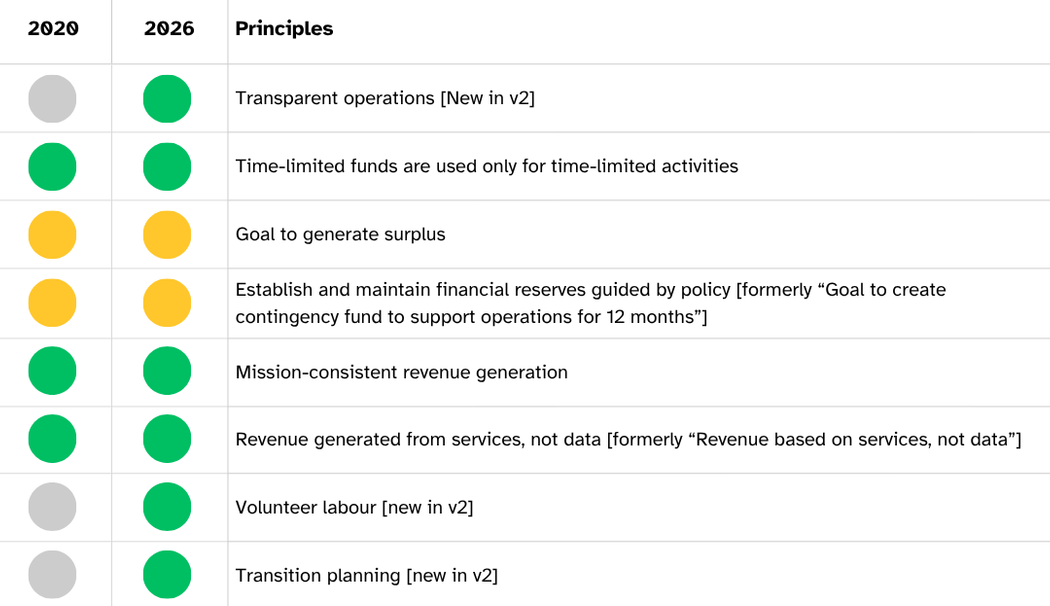
While ROR has always maintained transparency in terms of code and technical development, other aspects of its operations have not always been transparent and we therefore have taken deliberate steps to increase transparency on various fronts.
ROR’s curation process began transitioning to GitHub in 2020 and was made fully transparent and operational in 2022. Anyone with or without a GitHub account can access registry curation requests in the pipeline, view decisions that are made, and track when updates are implemented.
ROR’s product development roadmap is also publicly available on GitHub and users are invited to follow progress and submit issues for consideration.
The Memorandum of Agreement that outlines ROR’s operating and governance model is publicly available on the ROR website. The ROR website includes additional documentation about ROR operations, such as information about current team members and a timeline of how ROR first emerged. ROR has also begun posting annual financial reports on the website that go back to 2023 following the establishment of its current operating model in 2022. We do not currently make detailed financial information publicly available, such as staff salaries, or the amounts that individual organizations contribute to ROR.
Organizations and community members that participate actively in ROR operations are acknowledged on the website, including financial contributors, Curation Advisory Board members, and Steering Group members. We do not publicize the names of community members on our mailing list or those who attend our community meetings.
We continue to identify and consider future opportunities to make operations more transparent to ensure trust and also provide useful information for the community. Such areas could include documentation about how we run community meetings and structure community groups, incident response operations, and communication guides.
When ROR was first being established, it was resourced through a mixed and unpredictable funding model that combined in-kind support, grant funding, and community investments. As of 2022, ROR’s core expenses, including personnel, are currently funded through in-kind support from ROR’s operating organizations and are not dependent on any time-limited funds. ROR receives additional ad hoc contributions from community supporters but this is not our primary source of funding.
ROR does not charge for access and usage and does not intend to do so in the future.
ROR’s core operating costs have stable funding from its operating organizations, plus additional funds from organizations that provide ad hoc financial support for ROR. We maintain reserves to carry forward 1-2 years. We review our budget throughout the year to anticipate any volatility.
In addition to outlining support for ROR’s ongoing operations, ROR’s Memorandum of Agreement specifies procedures for winding down ROR operations and transferring assets as needed.
ROR’s financial planning and modeling processes are carried out by representatives of its operating organizations. ROR does annual and mid-year forecasting to anticipate any unforeseen expenses.
ROR aims to keep costs as low as possible while effectively and sustainably supporting core expenses and operations. ROR adheres to an informal policy of maintaining reserves to carry forward 1-2 years and we are working to codify this policy and make it more transparent and durable.
ROR has no revenue model and no current plans to offer a paid service; our objective is to continue offering ROR data and services freely available to everyone.
While ROR explored different potential revenue models during its startup phase, the ROR operating organizations made a decision in 2022 to fund ROR’s core operating expenses on a long-term basis so that ROR could continue to operate as a free and open service for everyone without being dependent on time-limited funding and without needing to develop a paid service model or distinct revenue stream.
ROR receives additional ad hoc funds from contributor organizations that believe in our mission. These are not directed contributions and there is no reward or “pay-to-play” option offered in exchange for these contributions. Such contributions help to offset ROR’s operating expenses and support time-limited activities. ROR does not depend on these contributions to be operational.
ROR has received grant funding in the past for time-limited activities. In the future, we may pursue additional grant funding for time-limited projects in accordance with our strategy and mission.
ROR makes both its data and services openly available for free. Data and code are made available under a CC0 waiver and MIT license, respectively. Our aim is to continue operating ROR as a free and open dataset and service.
While a value-added service model was considered after ROR’s initial launch, we have no current plans to develop any paid services. We may consider some service access constraints in the future such as API credentials to ensure overall stability and performance of our services, but such changes would not involve a fee model.
ROR has a dedicated team of paid staff members that provide support for ROR’s core operations. While ROR operates as a community-driven initiative, and regularly seeks community input and engagement to inform its operations and strategic directions, it does not rely on community volunteers for essential operations.
In the early days of the initiative, ROR relied on some community volunteers to advise on curation processes. We identified when this level of involvement was no longer viable and needed to be replaced with dedicated resourcing. We have not otherwise relied on volunteers for any core activities.
ROR’s Memorandum of Agreement supports continued staffing of core personnel roles so that we can ensure ongoing support for key functions. We have processes and logins documented and centralized to support continuity of institutional knowledge, and we have experienced staff transitions to test the quality of these safeguards, both in terms of staff members switching organizations and also leaving entirely. We maintain comprehensive onboarding and offboarding checklists for joining and departing team members, and documentation for new hires. Our technical processes are documented and regularly reviewed with backup support.
Like any small, mission-driven, community-oriented initiative, ROR depends on a limited number of passionate individuals who dedicate time and energy to their work and who have established trusted relationships with advisors, users, and stakeholders. While we have put several measures in place to make sure that we are not dependent on specific individuals such that we would be at risk of collapse, any departure of key personnel will always have an impact, and it would be naive to assume otherwise.
Insurance
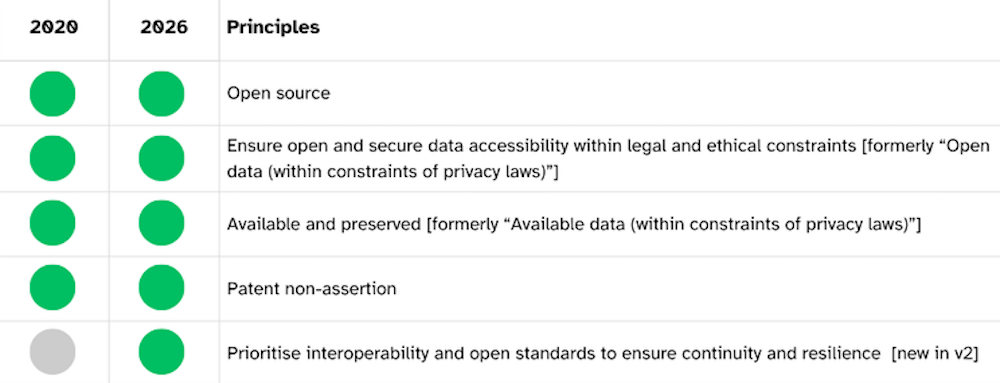
All of ROR’s code and software processes are openly stored and documented on GitHub. Code is published under a fully permissible MIT License. We rely on additional tools and software to support our development work, such as hosting and logging. Wherever possible, we leverage open source components. We provide extensive documentation about how to access and query ROR data, and how to run the REST API locally, to enable other projects to use our data and code.
The ROR dataset is made openly available under the terms of a CC0 waiver and can be accessed via ROR’s data file or by querying the ROR API. ROR code is openly available and forkable under the terms of a MIT License.
No private or privileged information is included in the ROR dataset. ROR has a privacy policy published on our website that outlines how we handle private information, such as personal details of individuals on our community mailing list.
ROR data is openly available under a CC0 waiver and can be accessed in multiple ways, all of which are publicly documented. The ROR data file is published on the Zenodo digital repository and is subject to Zenodo’s preservation practices, which include regular backup, replication, and fixity processes, a retention policy of at least 20 years, and succession planning in the event of repository closure.
ROR code is available on GitHub under the terms of a MIT License and code repositories are automatically archived in Software Heritage. The archiving schedule is determined by Software Heritage. We may consider other automated or proactive mechanisms for code preservation moving forwards.
ROR is a fully open and public registry of factual information about research organizations. The metadata practices and curatorial stewardship that we apply to ROR registry data are not considered to be intellectual property of any ROR-related entity. Due to its factual nature, the information stored in the registry cannot be copyrighted or patented. In addition, ROR asserts no claims to registry data via the application of the CC0 1.0 public domain dedication.
ROR data can be accessed easily without proprietary extensions or software. For example, the ROR data file is available in both json and csv formats, and any integration can retrieve metadata via the REST API.
Feed
Categories
Archives
Tags
- adoption
- annual-meeting
- api
- aps
- caltechdata
- cambridge-university-press
- clarivate
- clear-skies
- coki
- communication
- community
- cris
- cross-post
- crossref
- curation
- curvenote
- data
- datacite
- datasalon
- development
- digicorepro
- digital-science
- discovery
- dryad
- earthscope-consortium
- europe-pmc
- facilities
- fairsharing
- feedback
- figshare
- funders
- governance
- grei
- grid
- guest-post
- hhmi
- hierarchy
- highwire-press
- implementation
- integrations
- interviews
- inveniordm
- janeway
- jobs
- latin-america
- machine-learning
- matching
- metadata
- metadata-game-changers
- mps
- mvr
- nwo
- oareport
- oaworks
- open-access
- open-infrastructure
- openalex
- optica
- orcid
- osf
- persistent-identifiers
- pidapalooza
- pids
- posi
- prototype
- publishers
- publishing
- registry
- repositories
- requests
- research-integrity
- researchequals
- resources
- rockefeller-university-press
- rrid
- schema
- scholastica
- scilifelab
- silverchair
- skgs
- steering-group
- straininfo
- sustainability
- symplectic-elements
- team
- usdot
- web-of-science
- working-group
- zenodo