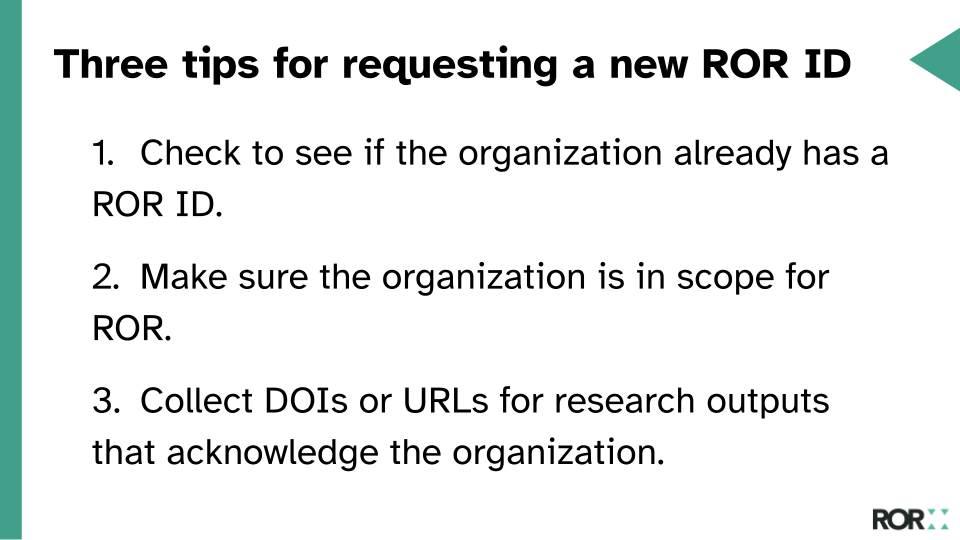
When you’re requesting a new ROR ID for an organization, here are the three most important things to do before you fill out the request form: 1) Search the registry to see whether the organization already has a ROR ID, 2) Make sure the organization is in scope for ROR, and 3) Collect links to research outputs such as journal articles or datasets that acknowledge the organization as an author affiliation, funder, or publisher.
Read on or watch our video how-to for more guidance on making sure your request for a new ROR ID is processed quickly and ultimately approved.
ROR request process explained
ROR is a community-curated registry, meaning that anyone can ask for an update to an existing ROR record or request a new ROR record using our public request form. There’s never any associated cost with requesting updates to the registry, and there’s no need for you to become a member or create an account, since ROR by design has no membership model and no user accounts.
Our metadata policies and inclusion criteria have been established by our community, including our international volunteer Curation Advisory Board. We process hundreds of requests every month submitted by users all over the world, and the process is completely open so that anyone can see the requests on the web in our registry updates tracker. We don’t publish any personal information, so the names and email addresses of the people who send us requests are always kept private.
When you submit the request form, you’ll be emailed a link where you can track the progress of your request. We publish new versions of ROR at least once a month and usually more often, so you’ll typically know the status of your request in 4-6 weeks.
So that’s the request process in a nutshell! Before you begin, however, here are three things you can do to help everything go smoothly.
Tip 1: Search the registry to see if the organization already has a ROR ID
If you’ve only recently learned about ROR, you might assume that a given organization doesn’t yet have a ROR ID. But there are currently over 120,000 organizations in the registry, and the one you’re thinking of might be one of them! Before you fill out the request form, then, you should do a quick and easy search to see if the organization you want a ROR ID for is already in the registry.
ROR has a web-based search tool that makes it simple to find the ROR ID for an organization, if it exists. The search box is embedded on our home page at https://ror.org and is also available at https://ror.org/search.
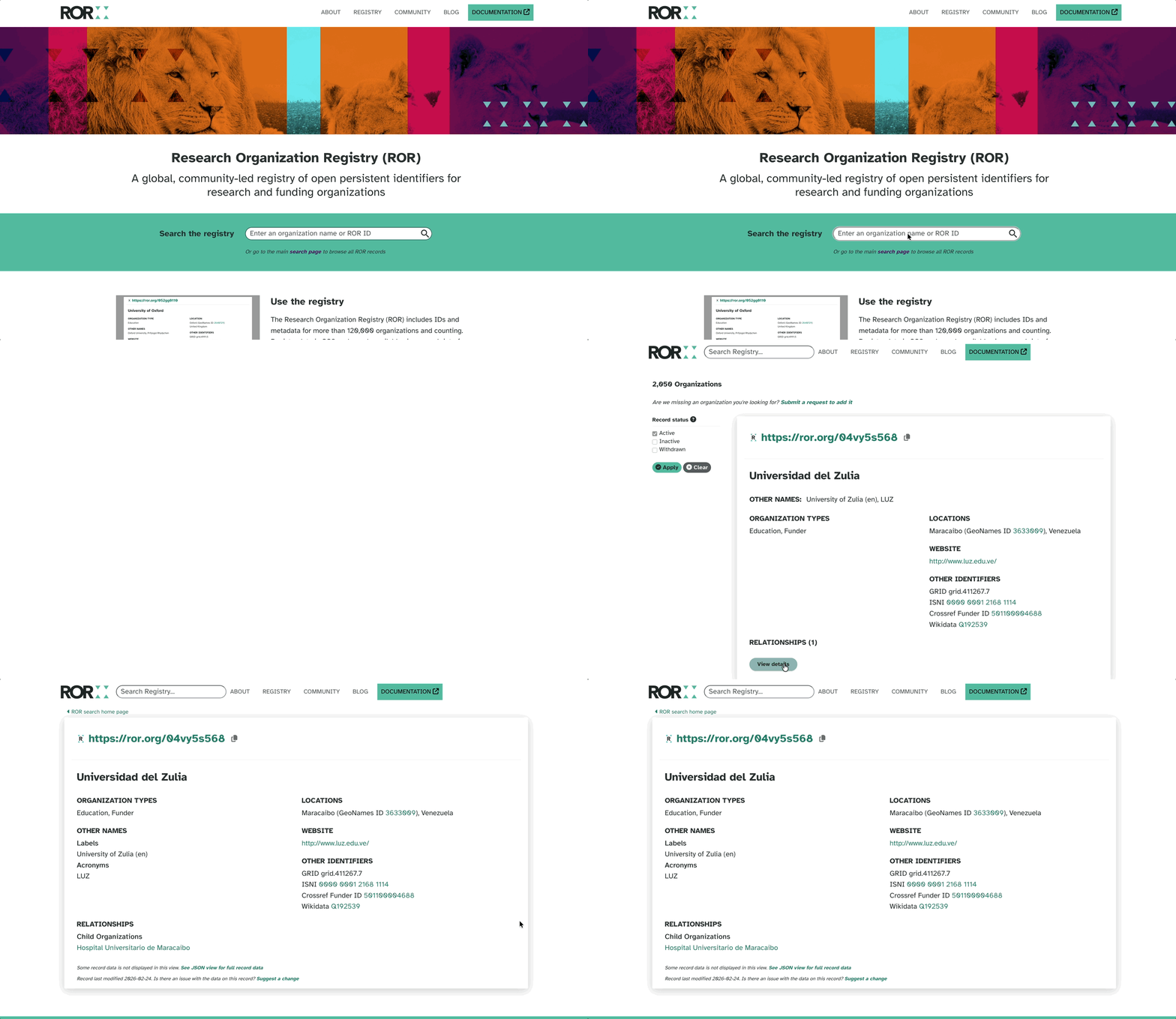
Searching ROR shows that there is an existing record for the Universidad del Zulia, so there is no need to ask us to add a new record to ROR for the organization.
If your search returns too many results so that you’re not sure if the organization you’re looking for is already in ROR, try surrounding the name of the organization with quotation marks, as in “Universidad del Zulia.” If the name of the organization includes a unique word such as “Zulia,” you can also try searching for only that unique word, since that will produce fewer results. Soon, when we release a new version of the ROR web search, you’ll also be able to narrow your search to a specific location for the organization.
In recent years, we’ve logged hundreds of new ROR ID requests for organizations that already have ROR IDs. If an organization is already in ROR, hooray! There’s no need to request a new ROR ID for it.
Tip 2: Make sure the organization is in scope for ROR
Another great step to take before filling out the request form is to review our scope and criteria for inclusion to make sure the organization is in scope for ROR. Remember that ROR is the Research Organization Registry, which means that ROR is a registry of research and funding organizations. In other words, records in ROR represent independent, enduring, collective entities that are involved in the production and sponsorship of research. ROR includes over 125,000 organizations (so far) from around the world that conduct, fund, and publish research: companies, universities and colleges, government agencies, nonprofits, scholarly societies, independent research institutes, independent research laboratories and facilities, independent museums and libraries, healthcare clinics and hospitals, and more.
ROR’s primary purpose is to enable research outputs to be connected to research organizations in scholarly metadata, and including too many non-organization entities in ROR would make ROR data much more complex and therefore much harder to maintain and to use. Therefore, subdivisions within a single organization are generally not in scope for ROR. Entities such as university faculties, colleges, and departments do not receive their own ROR IDs, since they do not function independently of their “parent” organization and are created, closed, renamed, and otherwise altered more often than their parent organizations. Similarly, internal divisions of companies are out of scope for ROR, as are funding programs and schemes. Entities do not need a legal status as an organization to qualify for a ROR ID, but they do need to function with a high degree of stability and independence.
ROR does support organizational hierarchy and relationships, but “child” and “related” organizations with their own ROR IDs have demonstrated independence from the organizations to which they are related. In the ROR record for Heidelberg University, for instance, 4 differentiated child organizations do not depend solely on Heidelberg University for their ongoing support and operation. Moreover, researchers frequently cite these child organizations in published research without reference to Heidelberg University. That’s a crucial signal that they function as research organizations.
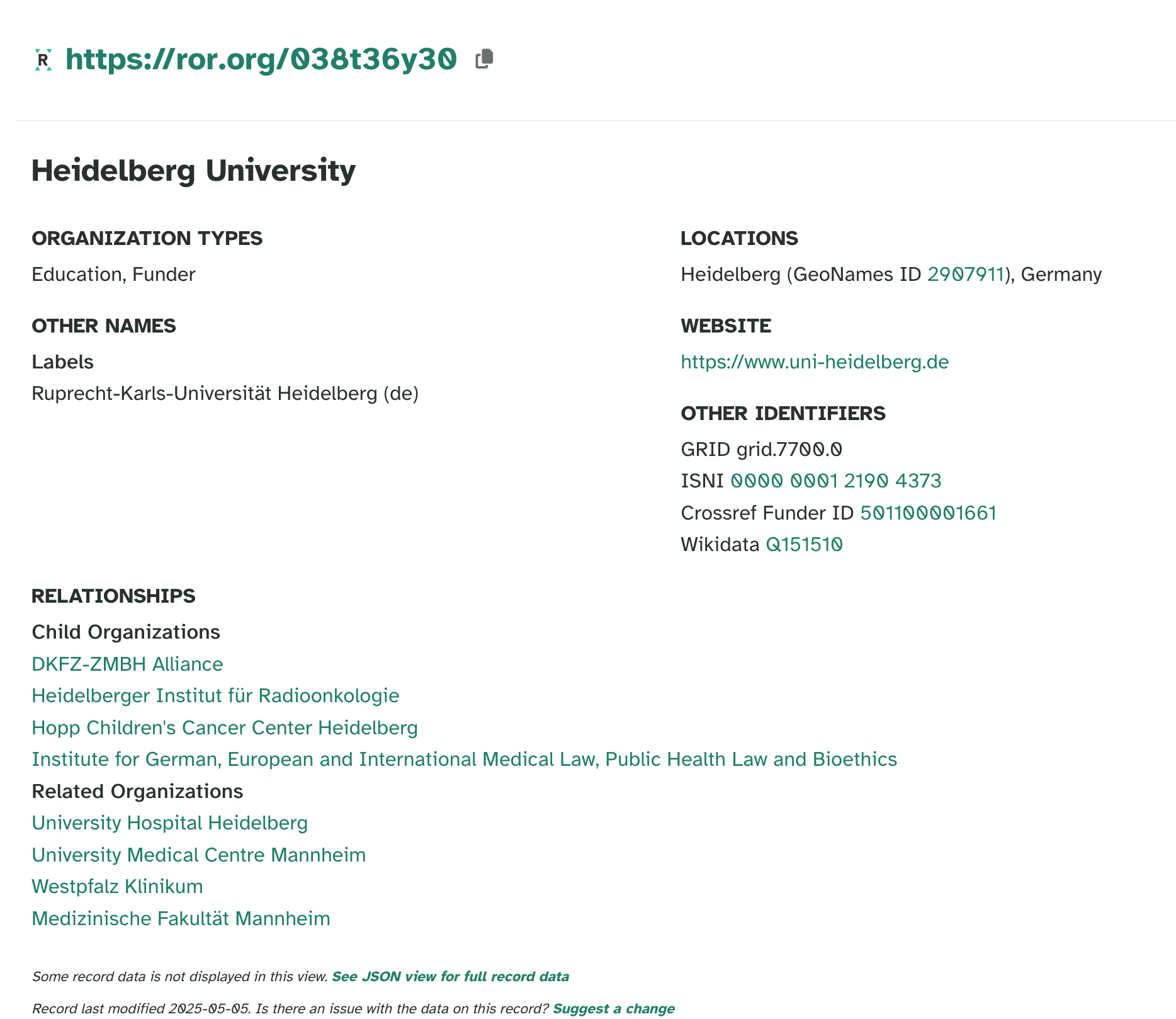
The DKFX-ZMBH Alliance and other child organizations listed on the record for Heidelberg University operate with a significant degree of independence from their parent and thus have their own ROR IDs.
When a large organization has multiple separate locations, those separate locations are not treated as subdivisions when they operate with a significant degree of independence. In these cases, each location warrants its own child ROR ID, which means that research outputs can be linked to separate locations. ROR records for public university systems, multinational NGOs and nonprofits, and multinational corporations are frequently structured in this way, as for instance the University of Wisconsin system at https://ror.org/03ydkyb10, UNICEF at https://ror.org/02dg0pv02, and Thermo Fisher Scientific at https://ror.org/03x1ewr52.
Some independent, standalone research entities might not be in scope for ROR. Specifically, single-person organizations are not in scope for ROR, even if they are legally recognized as organizations. Individuals are better identified using ORCID IDs. Independent scholars and researchers whose organizations are not in ROR should be able to enter their affiliation as plain text in scholarly systems in accordance with ROR’s recommendations.
We’ve received more than 2,000 requests to create ROR IDs for entities that are not in scope for ROR, so this is one of the most common situations that you can avoid. However, if you’ve read the above and you’re still not sure whether an organization is in scope for ROR, take a look at our third tip.
Tip 3: Collect links to research outputs that acknowledge the organization as an author affiliation, funder, or publisher
The most important thing we look for when evaluating an organization for inclusion in ROR is whether that organization is involved in research, and the most important piece of evidence showing that an organization is involved in research is when the organization appears as an affiliation, funder, or publisher in research outputs such as journal articles and datasets.
Therefore, requests for new ROR IDs are most likely to be successful when they include several links to reputable research outputs in which more than one person acknowledges the organization by name.
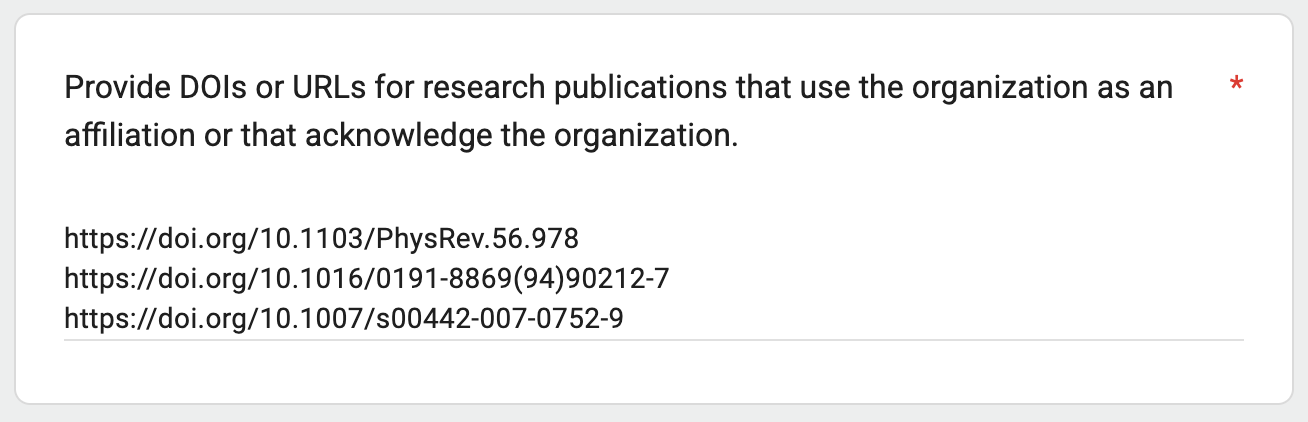
Example of links to reputable research outputs that acknowledge the organization as a funder, publisher, or affiliation of an author / creator / contributor.
As we mentioned earlier, we’re also looking for evidence that the organization is a collective and enduring entity, not a single-person organization, so ROR curators check to make sure that more than one person uses the organization as an affiliation or acknowledges it as a funder. It also helps if the research outputs provided were published in multiple channels, as for instance in more than one journal. These are signs of an organization that is seriously involved in substantive research.
Note as well that the name of the organization in the request should match the name of the organization as it’s used in research outputs. For instance, if you request a new ROR ID for “The Sri Lankan Health Institute” and the name used in research outputs is “Health Institutes of Sri Lanka” it will take ROR curators longer to evaluate and process the request. You can always include common organization name variants and names for the organization in different languages in your request, and in fact we recommend that you do so in order to ensure that the ROR record for the organization is as complete as possible.
ROR curators are also looking for evidence that the organization is cited in research outputs without reference to any related or parent organizations. If researchers frequently cite Health Institutes of Sri Lanka alone as their affiliation even though that organization is part of the larger Biomedical Academy of Sri Lanka, that’s evidence in favor of providing a new ROR ID for Health Institutes of Sri Lanka.
What if the research organization is newly established or a startup? In that case, it might be too soon to request a ROR ID. You can always request a ROR ID for the organization once it has demonstrated evidence of research activity.
When in doubt, ask
Still not sure about the process? You can email us at support@ror.org with any questions, and we’ll be happy to advise you.
We hope these tips are helpful! As a community-driven initiative, we rely on the global research community – that is, you – to make ROR data the best it can possibly be.
Feed
Categories
Archives
Tags
- abes
- adoption
- annual meeting
- api
- aps
- aries systems
- caltechdata
- cambridge university press
- clarivate
- clear skies
- coki
- communication
- community
- cris
- cross-post
- crossref
- curation
- curvenote
- data
- datacite
- datasalon
- development
- digicorepro
- digital science
- discovery
- dryad
- earthscope consortium
- editorial manager
- europe pmc
- facilities
- fairsharing
- feedback
- figshare
- funders
- governance
- grei
- grid
- guest post
- hhmi
- hierarchy
- highwire press
- implementation
- integrations
- interviews
- inveniordm
- janeway
- jobs
- latin america
- machine learning
- matching
- metadata
- metadata game changers
- mps
- mvr
- nwo
- oareport
- oaworks
- open access
- open infrastructure
- openalex
- optica
- orcid
- osf
- persistent-identifiers
- pidapalooza
- pids
- posi
- prototype
- publishing
- registry
- repositories
- requests
- research integrity
- researchequals
- resources
- rockefeller university press
- rrid
- schema
- scholastica
- scilifelab
- scoss
- silverchair
- skgs
- steering group
- straininfo
- sustainability
- symplectic elements
- team
- usdot
- web of science
- working group
- zenodo