France’s Bibliographic Agency for Higher Education and Research (ABES) explains how and why thousands of French dissertations are so well-described in Crossref DOI metadata with ROR IDs and more.
A French version of this post is available on the ABES blog. Many thanks to Carlos Riquelme for assistance with English translation.
What the heck is ABES and how has it become the second-largest provider of ROR IDs in Crossref metadata?
ABES stands for Agence bibliographique de l’enseignement supérieur (Bibliographic Agency for Higher Education and Research)1 and was created in 1994 as a public body. Its initial goal was to create a national union catalogue for all university libraries in France, based on shared cataloguing, known as Sudoc (Système Universitaire de Documentation). A particular emphasis was then placed on managing PhD theses, as ABES became in charge of the legal deposit of all doctoral dissertations defended in France with a nationwide statutory mandate; not only are they present in the Sudoc, but they are described in a rich metadata model (TEF, details in French on the ABES website) using software developed in-house by ABES and made available through a dedicated portal: theses.fr.
The tracking and identification of French PhD theses started in 1985 by assigning an identifier called NNT (Numéro National de Thèse). The NNT combines 3 parts of 4 characters: the first is the year, the second is a code for the institution that grants the diploma and the last sequence is attributed by the organisation on a unique basis, mostly incrementally.
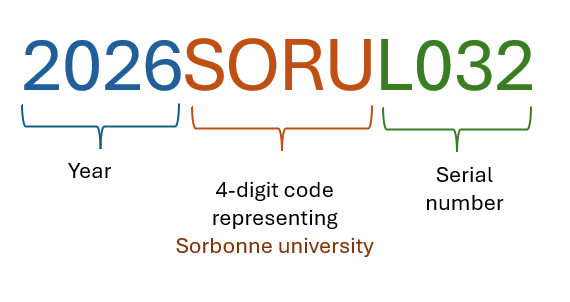
Structure of the French Numéro National de Thèse.
A URI for each French thesis can be built using the prefix theses.fr/ and adding the NNT; highlighting ABES’ early concern about promoting identifiers and Open Science. The URI for this thesis is https://theses.fr/2026SORUL032.
From national cataloguing to a PID strategy
As has been the case across many other countries, a national strategy for open science and the adoption of persistent identifiers has been put in place in France. The French ministry for higher education and research in its effort to promote PIDs entrusted ABES with a project to assign Crossref Digital Object Identifiers (DOIs) to all French doctoral dissertations, with two major goals:
Enhance digital preservation by relying on a robust, well-established international identifier schema such as the DOI
Build on and benefit from Crossref infrastructure and presence in the ecosystem.
The project was kicked off in 2025 with an ABES team with Carlos Riquelme as Product Owner. The Crossref metadata schema (now at version 5.5) is not as tailored for detailed description of theses as the TEF format that includes subject indexing and peculiar relationships such as jury [dissertation committee] members. And Crossref only accepts the crème de la crème as PIDs: ORCID for individuals and ROR for organisations, which are not natively present in the thesis metadata because theses are described using ABES’ own reference database, called IdRef. Derived from the authority file of our good old Sudoc, IdRef underpins several bibliographic databases, including theses.fr, but also library catalogs in French-speaking countries in Europe (University of Liège in Belgium; Swiss networks RERO, Renouvaud, and SLSP) and publishers (Cairn, OpenEdition). IdRef is used as a source of trusted data for individual contributors, organisations, and key concepts.
How does IdRef connect people and organisations?
How did ORCID and ROR IDs make their way into IdRef data? No magic – it is the result of the combined effort of a distributed network of 3,000+ catalogers feeding into the databases (Sudoc, theses.fr, and so on), and a centralized coordination by ABES.
Regarding ORCID, the longstanding relationship started with a Memorandum of Understanding in 2016. Alongside co-leading the French ORCID consortium together with Couperin, ABES focused on the gigantic data dump provided yearly by ORCID, aiming to scrutinize French adoption of the most prominent PIDs for individual contributors, and matching ORCIDs to IdRef IDs based on algorithm analyzing co-authorship. In September 2026, almost 195,000 IdRef records carry an ORCID as an external identifier – and this is 18% more than the previous year. Toggling from an IdRef record to an ORCID is seamless: a micro API designed as https://www.idref.fr/services/idref2orcid/[idref] gives an instant result, as in the example below:
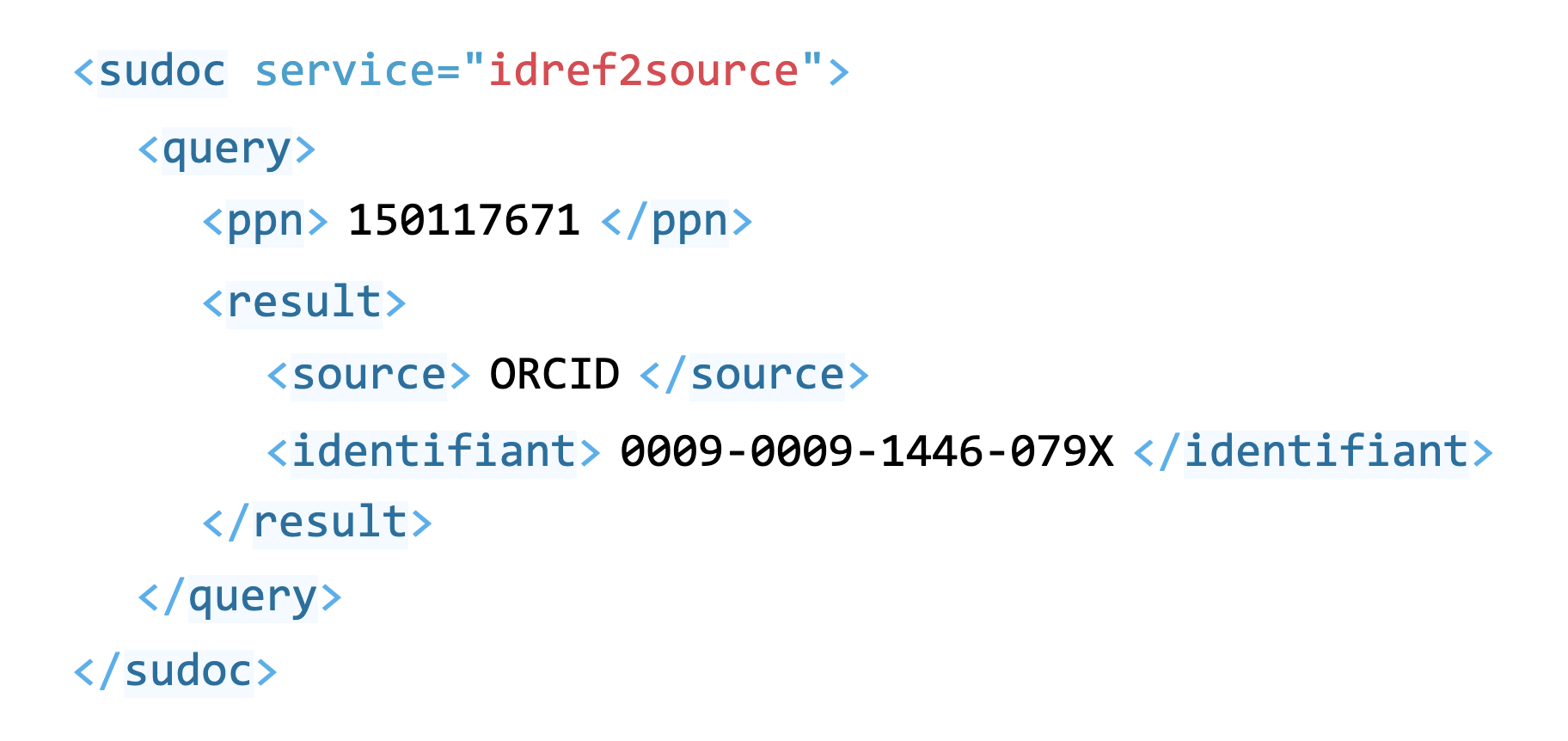
IdRef markup with an ORCID ID. https://www.idref.fr/services/idref2orcid/150117671
It is exactly the same process to jump from an IdRef to a ROR ID, this time using the micro API https://www.idref.fr/services/idref2ror/[idref], as in the example below:
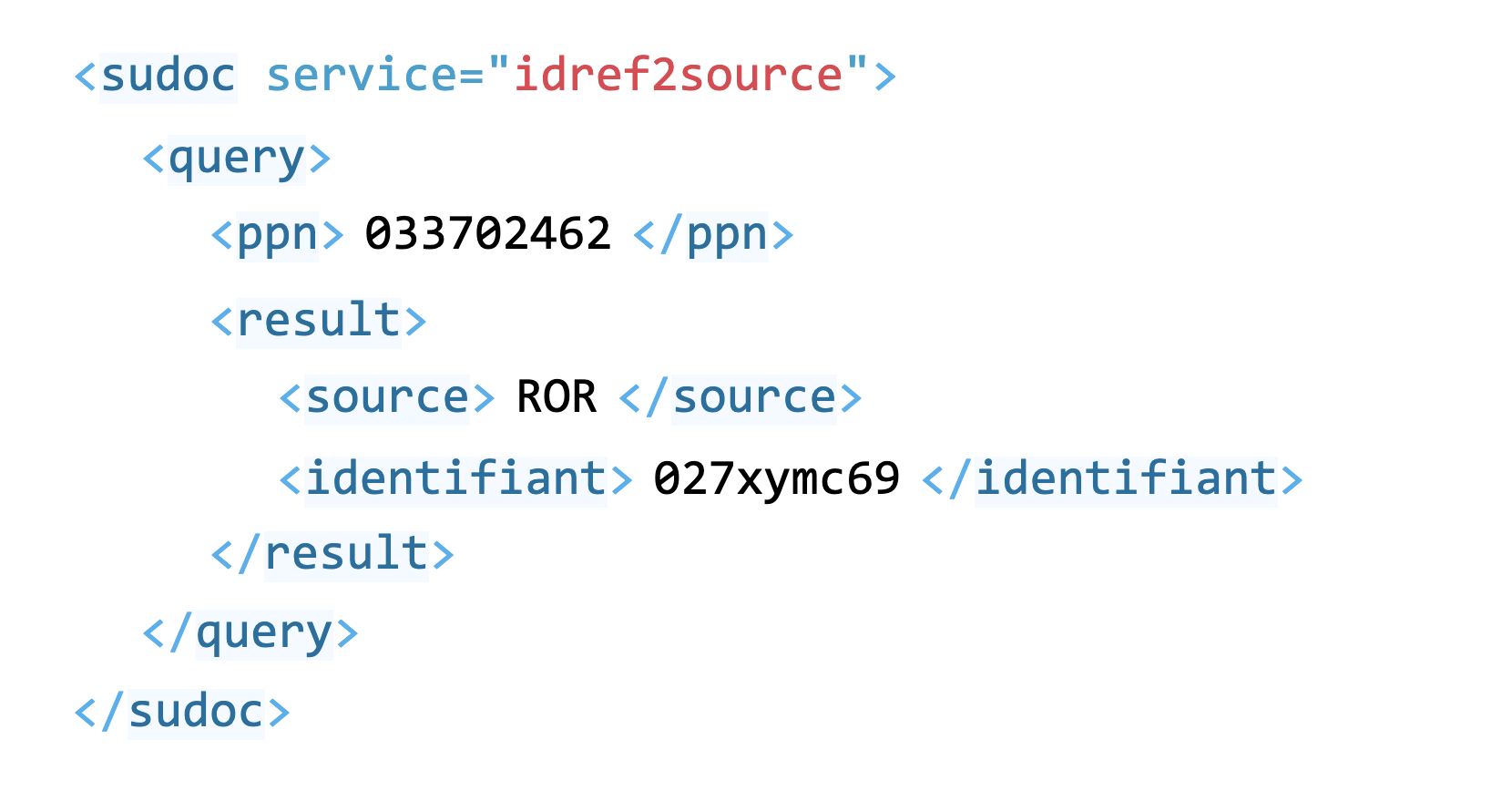
IdRef markup with a ROR ID. https://www.idref.fr/services/idref2ror/033702462
Maintaining the matching between IdRef and ROR is dead easy for this use case, as there are only 220 research organisations involved. Some of them change, as the French higher education and research landscape has been rather dynamic those past 15 years, with constant mergers and legal status changes. Fortunately ABES relies on local librarians to track those changes. Again, for all IdRef records (including labs and other facilities) the matching with ROR is the result of aggregate efforts of our invaluable network of librarians on top of the centralized action that ran modestly during 2021-2024 (more details in French on the ABES blog). The matching for organisations associated with PhD theses, due to the small volume, has involved a good bit of manual work, allowing human eyes to do careful checking.
As always, a huge thank you to ROR curation team, and especially Adam Buttrick, for all the help along the way!
From French PhD theses to global research visibility
It’s worth pointing out that, although ROR and ORCID are “recommended” by Crossref, at ABES we decided to go the extra mile and make ROR IDs part of our mandatory metadata when registering DOIs. As a result, ROR IDs are now included, and ORCIDs whenever available, in every DOI deposit for a PhD thesis in France.
Almost 180,000 Crossref DOIs have been registered for back-year PhD theses in April 2026, and this does explain the sudden appearance of ABES at the top of the list of organisations registering ROR in Crossref metadata. But DOI registration is now an ongoing process for French PhD theses, and we expect around 10-13,000 to be added each year. We’re going up, up, up – it’s our moment! 😉
Having ORCID and ROR IDs in French PhD theses’ metadata spread over the world thanks to Crossref’s robust infrastructure should enhance French research’s visibility: today, 33,000+ ORCID profiles have been updated with the PhD thesis as a Work, due to researchers’ accepted delegation to Crossref. The whole process shows the pivotal role of national PIDs such as IdRef to connect local knowledge and international science, in line with the seminal white paper by MoreBrains: It’s “ORCID and…” , not “ORCID or…”.
There are 3 candidates in ROR searching for “ABES”, the two other located in India and Pakistan. 😉 ↩︎
Feed
Categories
Archives
Tags
- abes
- adoption
- annual meeting
- api
- aps
- aries systems
- caltechdata
- cambridge university press
- clarivate
- clear skies
- coki
- communication
- community
- cris
- cross-post
- crossref
- curation
- curvenote
- data
- datacite
- datasalon
- development
- digicorepro
- digital science
- discovery
- dryad
- earthscope consortium
- editorial manager
- europe pmc
- facilities
- fairsharing
- feedback
- figshare
- funders
- governance
- grei
- grid
- guest post
- hhmi
- hierarchy
- highwire press
- implementation
- integrations
- interviews
- inveniordm
- janeway
- jobs
- latin america
- machine learning
- matching
- metadata
- metadata game changers
- mps
- mvr
- nwo
- oareport
- oaworks
- open access
- open infrastructure
- open source
- openalex
- optica
- orcid
- osf
- persistent-identifiers
- pidapalooza
- pids
- posi
- prototype
- publishing
- registry
- repositories
- requests
- research integrity
- researchequals
- resources
- rockefeller university press
- rrid
- schema
- scholastica
- scilifelab
- scoss
- silverchair
- skgs
- steering group
- straininfo
- sustainability
- symplectic elements
- team
- tnqtech
- usdot
- web of science
- working group
- zenodo