
TNQTech’s goal is to automatically match each author’s affiliation as stated in the manuscript against the ROR dataset and to insert the correct ROR ID wherever a confident match is found. Some publishers provide the ROR ID, but some only provide affiliation text. We have therefore set up a process to check the affiliation text against known organization names, aliases, and acronyms; first, the process looks for an exact match, then for a close (fuzzy) match if no exact match exists. If neither method finds a reliable match, the affiliation is flagged to the author in the proof stage.
Our affiliation matching process
We use the free ROR API service for our matching process, which has the following steps:
- Retrieve ROR Records: Use the ROR API to retrieve metadata for the relevant ROR IDs.
- Collect Name Variants: Extract the organization’s primary name, aliases, acronyms, and former or predecessor names.
- Prepare Variants: Combine, de-duplicate, normalize, and sort the name variants by character length.
- Exact Matching: Compare each normalized affiliation with the ROR variants; a 100% match is assigned the corresponding ROR ID and marked Matched.
- Fuzzy Matching: For affiliations without an exact match, apply fuzzy matching; matches with a similarity score of at least 90% are assigned the ROR ID and marked Fuzzy Matched.
We are offering this affiliation string to ROR ID matching as a free service to our publisher clients because we recognize that accurate affiliation metadata is essential for reliable research discovery, attribution, and institutional connectivity. We have also built a web interface for our team to use in affiliation matching that is openly available on GitHub for anyone to implement.
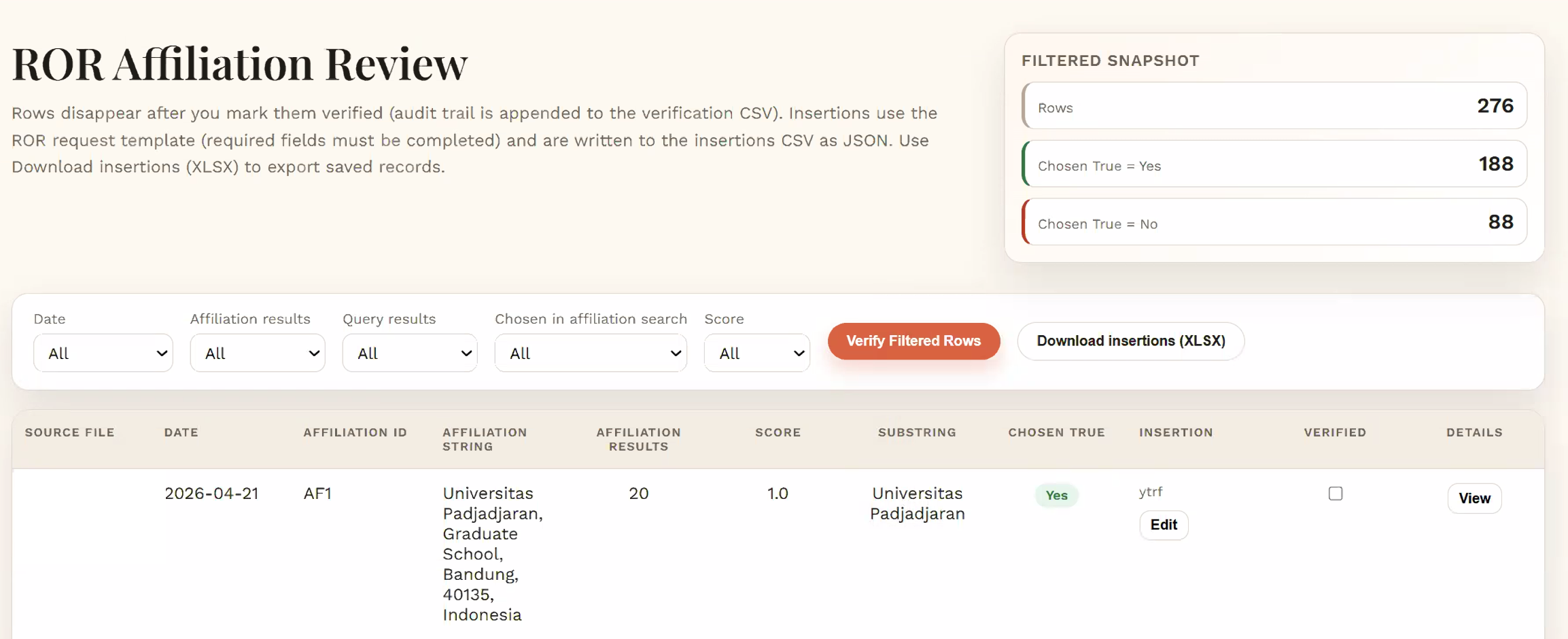
Our voluntary ROR curation process
Drawing on our rich experience working with article front matter—including titles, authors, affiliations, and correspondence—we also want to enrich ROR at scale to improve the consistency of metadata across indexing and discovery platforms. Our aim is to help ensure that institutions are correctly identified and credited, regardless of how their names appear in the source. Therefore, we have also set up a process by which we send unmatched affiliation strings to ROR so that they can be reviewed by ROR curators.
Where no match is found in our matching process, those records are flagged and compiled into a separate output template highlighting organizations that may need a ROR ID added. Reviewers then manually check these flagged records, and the findings are shared with the ROR curation team on a biweekly basis using ROR Bulk Processing templates. The ROR curation team then updates or adds organization records as needed.
ROR stands out as a free, openly accessible registry that provides persistent, unique identifiers for research organizations, solving the long-standing problem of inconsistent institution naming across scholarly records. The API itself is well-structured and reliable for bulk processing. Publishers should consider making ROR IDs mandatory for better discoverability and indexability.
Feed
Categories
Archives
Tags
- abes
- adoption
- annual meeting
- api
- aps
- aries systems
- caltechdata
- cambridge university press
- clarivate
- clear skies
- coki
- communication
- community
- cris
- cross-post
- crossref
- curation
- curvenote
- data
- datacite
- datasalon
- development
- digicorepro
- digital science
- discovery
- dryad
- earthscope consortium
- editorial manager
- europe pmc
- facilities
- fairsharing
- feedback
- figshare
- funders
- governance
- grei
- grid
- guest post
- hhmi
- hierarchy
- highwire press
- implementation
- integrations
- interviews
- inveniordm
- janeway
- jobs
- latin america
- machine learning
- matching
- metadata
- metadata game changers
- mps
- mvr
- nwo
- oareport
- oaworks
- open access
- open infrastructure
- open source
- openalex
- optica
- orcid
- osf
- persistent-identifiers
- pidapalooza
- pids
- posi
- prototype
- publishing
- registry
- repositories
- requests
- research integrity
- researchequals
- resources
- rockefeller university press
- rrid
- schema
- scholastica
- scilifelab
- scoss
- silverchair
- skgs
- steering group
- straininfo
- sustainability
- symplectic elements
- team
- tnqtech
- usdot
- web of science
- working group
- zenodo