
Case Studies
Why I Request ROR IDs for New Crossref Members
Collin Knopp-Schwyn of Crossref shares how they began contributing to the ROR dataset and discusses the value of ROR users providing curation requests to the registry.
Collin Knopp-Schwyn of Crossref shares how they began contributing to the ROR dataset and discusses the value of ROR users providing curation requests to the registry.

Joe Muller of the Open Library of Humanities tells us in this case study how and why the Janeway platform took the time to integrate ROR in a way that reduces the burden of data entry for authors, ensuring unambiguous author affiliations by retrieving ROR IDs from ORCID profiles as well as allowing authors to find their institution with a ROR-powered search.

John Lewis, Data Operations Manager at Cambridge University Press, tells us why and how Cambridge uses ROR in this latest installment of our short case study series.

In this interview with HighWire Press's Tony Alves, we learn that thanks to customer requests and a PID-aware development process, the publishing platform DigiCore Pro uses ROR in form lookups and automatic extraction processes for author affiliations, funder identification, peer reviewer affiliations, user disambiguation, and research integrity.

In this interview with Curvenote cofounder Rowan Cockett, we envision a world in which an authoring and publication platform helps scientists collaborate earlier, publish faster, and easily use structured metadata to create fully connected and highly interactive publications and portfolios.
Optica Publishing Group was one of the earliest publishers to send ROR IDs to Crossref in DOI metadata. In this interview, we speak with them to learn more about their rigorous processes for cleaning organization names.
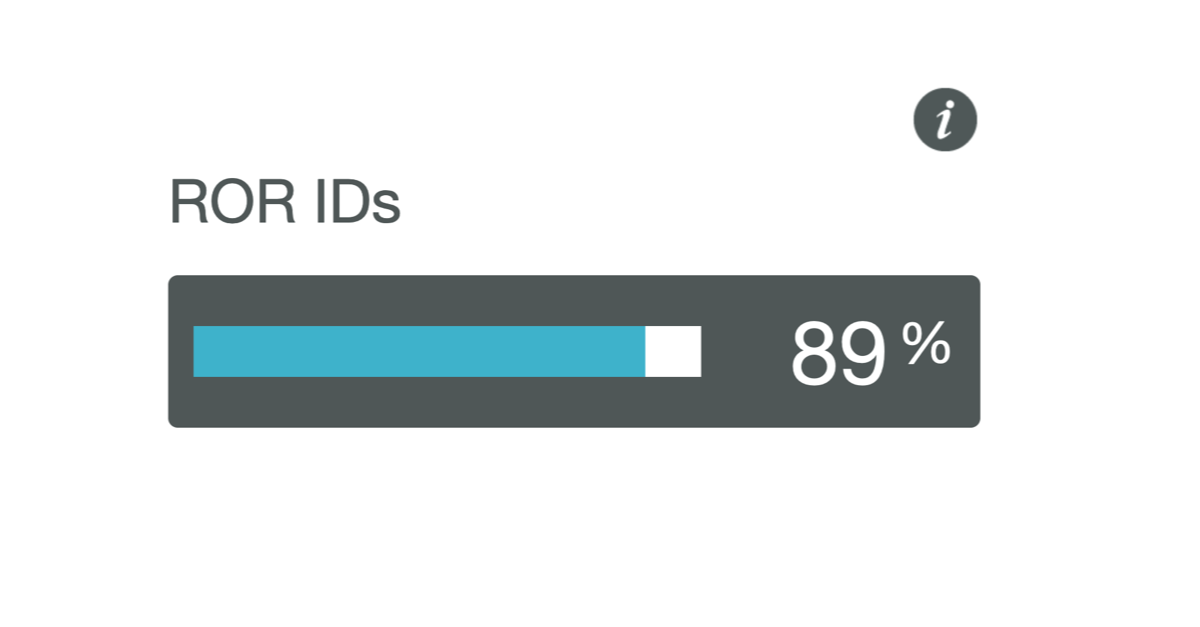
Crossref, with the help of CWTS Leiden, has just released an exciting update to their participation report, adding metrics for both affiliations in general and ROR IDs in particular. Now Crossref members can easily see how well they are doing in providing open affiliation metadata.
The American Physical Society (APS) has become the largest society publisher to adopt Research Organization Registry Identifiers. Institutional metadata in the Physical Review journals are now easier to find, track, and reference — a move that strengthens open science and research transparency.

Chris Hartgerink, the founder of Liberate Science, discusses why and how they integrated ROR into the modular publishing platform ResearchEquals for author affiliations in user profiles and Crossref DOIs and explains why they live streamed all eight hours of the work.

In January of 2022, DataSalon announced a full integration of ROR into its scholarly publishing analytics products MasterVision and PaperStack. DataSalon's Client Services Director Andy Dobson sat down with us to tell us all about how they draw on fifteen years of data experience to match organizational affiliations in publisher data to ROR IDs.