Case Studies

Case Study: ROR in FAIRsharing

In this installment of the ROR Case Studies series, we talk with Allyson Lister, Content and Community Lead for FAIRsharing, a cross-disciplinary registry of scientific standards, databases, and policies, about how and why FAIRsharing used ROR to help make organizations first-class citizens in their data model.

Continue reading

General Updates

Joy Owango and Natasha Simons Join ROR Steering Group

ROR is excited to welcome two new members to its Steering Group this year: Joy Owango from the Training Centre in Communication (TCC Africa) and Natasha Simons from the Australian Research Data Commons (ARDC).

Continue reading

Year in Review

ROR's Year in Review: 2022

2022 has been a momentous year for ROR! We experienced significant growth, reached critical milestones, and established a foundation for long-term sustainability. As the year comes to a close, we’re taking a moment to reflect on our activities and give thanks to our community for supporting us along the way.

Continue reading

Technical News

Schema Scheming: Evolving the ROR Data Model

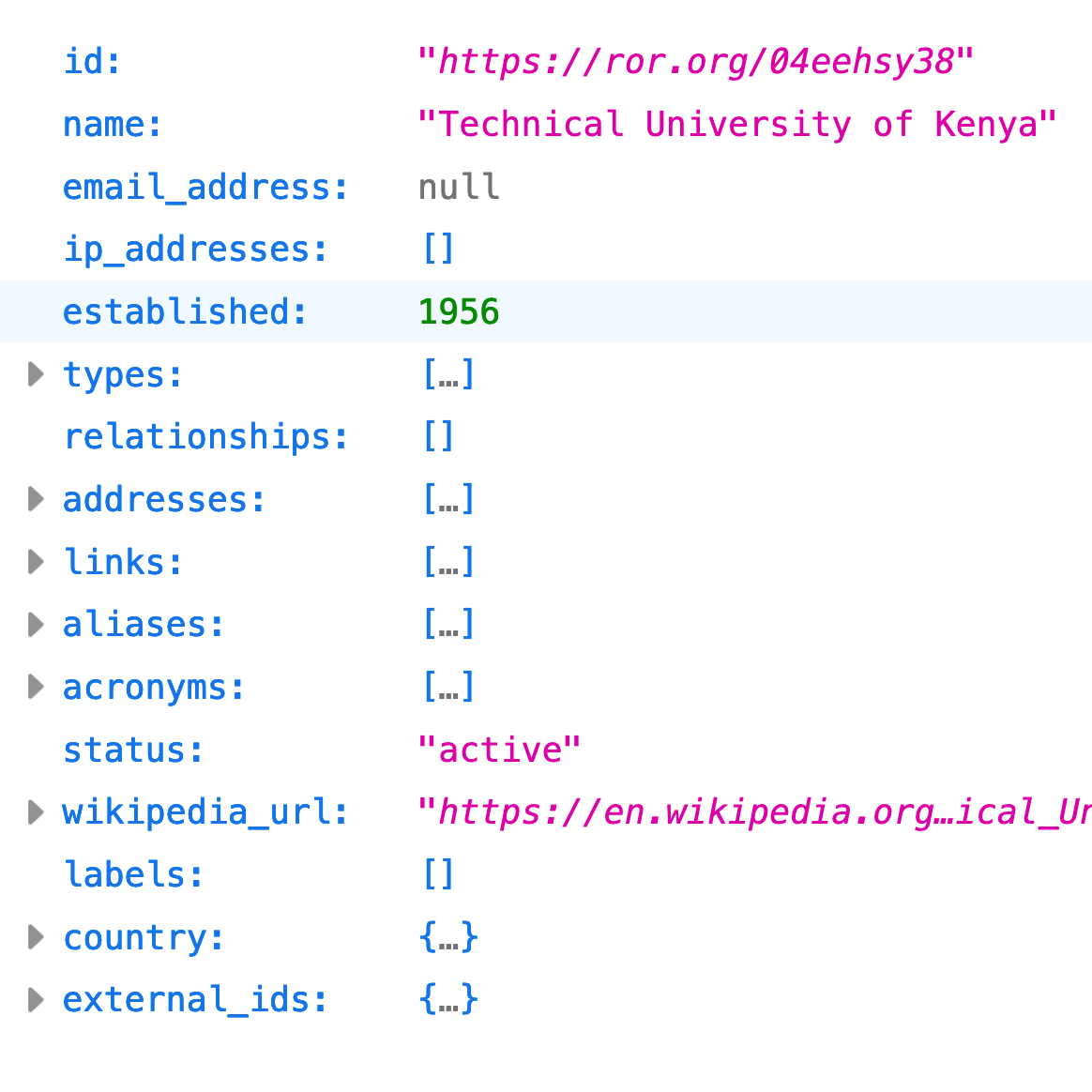
We’ve run several calls for feedback in 2022, but here’s one you’ll definitely want to chime in on: our draft proposal of major changes to the ROR data model for schema version 2.0. Comments are open until February 5, 2023, and we hope to release version 2.0 of the ROR schema and API in late 2023. When ROR diverged from GRID in March of 2022, it became possible for the first time to make changes to ROR’s data model. Our first priority was to handle inactive organizations and other organization status changes, and the community solution, as it turned out, didn’t involve any changes to the schema. We did the technical work to implement these organization status changes, and they were moved into production on December 1st, 2022. At the same time, knowing that both ROR’s data model and its API will need to change in the future, we asked for feedback on a proposal to handle schema and API versioning, and the ROR community agreed on a set of practices meant to make schema and API changes as painless as possible for ROR users.

Continue reading
Technical News

Handling Organization Status Changes in ROR

2022 was a big year for ROR in many ways, but it was especially notable from a tech standpoint. In early 2022, we built tools and processes that allowed ROR to begin curating the registry separately from GRID, which quickly opened possibilities for tackling projects that had been waiting on the back burner until ROR became fully independent.

Continue reading

Case Studies

Case Study: ROR in the COS Open Science Framework

This conversation with Eric Olson of the Center for Open Science is the first in a new series of interviews, “Case Studies in ROR Integration,” a series designed to provide in-depth detail on why and how people are choosing to integrate ROR IDs into their systems.

Continue reading

General Updates

SCOSS Selects ROR as Essential Open Infrastructure

We are thrilled to announce that ROR has been selected by SCOSS as essential open infrastructure and will be highlighted in the latest SCOSS campaign, which kicked off this week.

Continue reading

General Updates

Strengthening ROR’s Sustainability Model

Since its launch in 2019, ROR has been charting a unique path toward sustainability. In this blog post, we want to provide an update for the community on where this path is taking us.

Continue reading

Explainers

What's in a Name? Handling Name Metadata in ROR

The ROR registry includes unique IDs and associated metadata records for 100,000+ research organizations. Each one of these organizations has at least one name. Some of them have multiple names (one even has 15)! Organization names in ROR appear in 120 different languages and counting.

Continue reading

Team Updates

Welcome Amanda French, Technical Community Manager

We are thrilled to introduce a new member of the ROR pride: Amanda French has joined ROR as our full-time Technical Community Manager.

Continue reading